Durga Ashtami
|
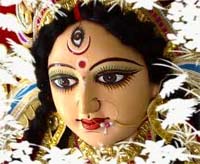
The Hindu festival of Durga Ashtami, also known as Maha Ashtami, is celebrated on the eighth day of the auspicious nine-day period of Navratri. It commemorates the time when the Goddess Durga stepped into a state of extreme power and strength required to conquer and kill Mahishasura, the demon buffalo. Time of Celebration Durga Ashtami Festival Dates: Durga Ashtami Festival Date 2025-30 September Durga Ashtami Festival Date 2026-19 October Durga Ashtami Festival Date 2027-7 October Durga Ashtami Festival Date 2028-26 September Durga Ashtami Festival Date 2029-14 October Durga Ashtami Festival Date 2030-4 October Legend The factor of being indestructible turned into arrogance, and everyone on the planet and in heaven suffered the demon’s arrogance. Once, when he attacked heaven, all deities came together to pray to the Lords of Trinity, i.e., Lord Brahma, Lord Vishnu, and Lord Mahesh. Acting on their request, the three deities unite their supreme powers to create one supreme power in the form of Goddess Durga or Shakti. On seeing Goddess Durga, Mahishasura got mesmerized by her beauty and proposed to her to get married to him. Durga accepted the offer, putting forth a condition that she would get married to him only if he could defeat her in a battle. Arrogant about his superiority over female power, he accepted it. When he got into the fight, it lasted for seven days. On the eighth day, i.e., on the day of Durga Ashtami, Durga gained a boost in her strength and power, and on the ninth day, she eventually beheaded the demon. Significance Rituals and Celebrations 2. One popular way of conferring devotion to the Goddess is by observing a fast. Both men and women observe it. It is one of the most important days in the period of Navratri, on which many people willingly choose to abide by a fast, as doing so derives immense blessings from the Goddess. Goddess Durga also confers that person with strength, courage, and determination enough to overcome and conquer all evils, fears, and negativities present within and around. 3. One of the major highlights of the celebrations held on this day is the display show of martial arts display, which also involves the use of arms and weapons. On the aspect of this context, the day is also referred to as ‘ Virashtami’, ‘ Astra Puja’, and ‘ Ayudha Puja’. This ritual is associated with the legend that it is on this day that Arjuna, the third of the five Pandavas, brought out his Ayudha from the Shami tree. 4. On this day, married women of the household offer things which are typically associated with married women such as clothes, jewellery, bangles, kajal, bindi, etc. to Goddess Durga. 5. The entire family participates in the worship ceremony of Durga. In the end, Bhog is offered to the Goddess. 6. The festive celebration of Durga Ashtami concludes with Sandhi Puja, which extends beyond to the next day's celebrations of Mahanavami.
All the information given above is general only, collected and reproduced for general information only. However, if you want some specific, exclusive and deep information, you may avail our specially designed services, for satisfying your thirst of knowledge.To quench your thirst of knowledge, Please click any one of the following: |